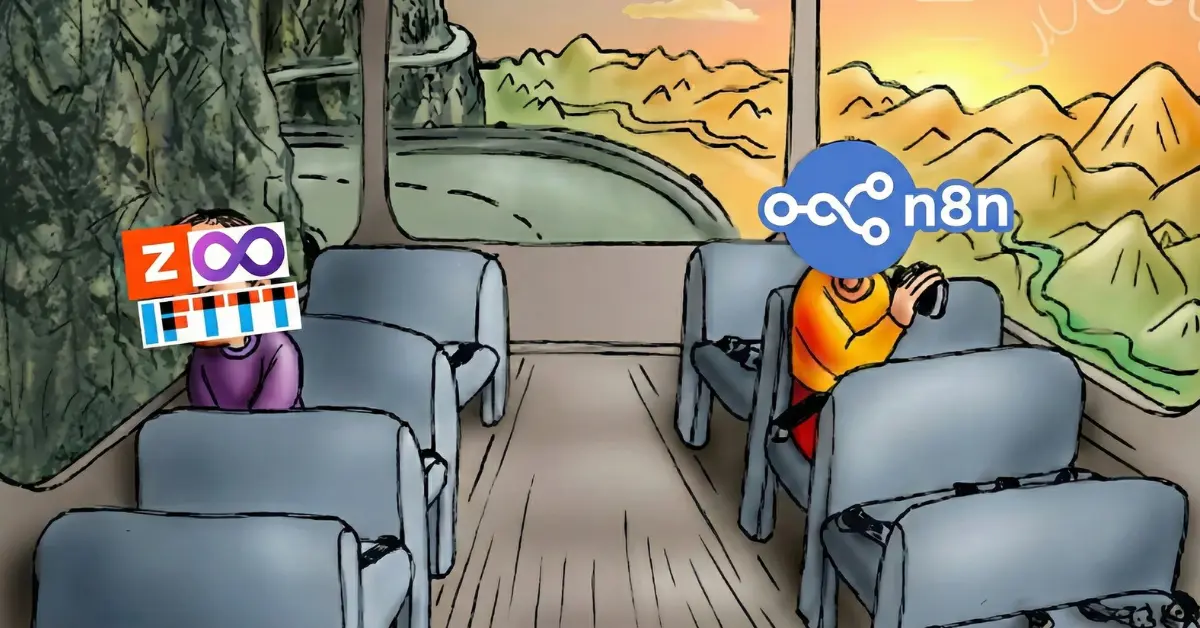
The silent revolution of workflow automation has finally reached everyone's hands. For over a decade, automating processes between different systems was a privilege of large corporations with generous budgets or depended on tools that charged heavily for every small action executed.
Then came n8n.
An open-source platform created in Berlin that, in less than six years, has earned over 163,000 GitHub stars, surpassed 230,000 active users, and reached a valuation of $2.5 billion in October 2025. More important than the numbers: n8n proved that it was possible to build powerful automations without spending a fortune or handing over data control to third parties.
This article provides a deep dive into how workflow automation has evolved, why traditional tools created artificial barriers, and how n8n shattered those paradigms. This is a dense, long article backed by extensive research—so get ready and sit back, because there’s quite a story to tell!
The World Before n8n: A Decade of Automation for the Few
To understand n8n's impact, we must first examine the landscape that existed before its arrival. The history of workflow automation for non-programmers began in 2010, when the idea of connecting applications without writing code seemed revolutionary.
IFTTT and the Birth of Simple Automation
In December 2010, Linden Tibbets and his brother Alexander launched IFTTT (If This Then That) in San Francisco. The proposal was elegant in its simplicity: create automatic "recipes" based on single triggers. If it rains, send a notification. If you post on Instagram, save the photo to Dropbox.
The platform quickly won over millions of users—reaching 32 million—but its fundamental architecture imposed severe limitations. IFTTT worked only with single-step linear flows. There was no way to create conditional branches, loops, or complex data transformations. When the company implemented a freemium model in September 2020, limiting free users to just three applets, the community reacted with frustration. The tool that promised simplicity revealed its structural limitations.
Zapier and the Consolidation of the Task-Based Model
A year after IFTTT, in October 2011, three freelance developers—Wade Foster, Bryan Helmig, and Mike Knoop—noticed they were building the same integrations repeatedly for different clients. From this frustration, Zapier was born, eventually becoming the giant of the category.
Zapier grew impressively, reaching $310 million in annual recurring revenue in 2023 and a $5 billion valuation in 2021. However, Zapier's pricing model created a fundamental problem. The platform charges by tasks—and every action within a workflow counts as a separate task. A flow with 10 steps processing 200 orders a day consumes 60,000 monthly tasks, which can easily exceed $899 per month. For startups, costs scale exponentially.
Integromat and Make
In Prague, a team led by Ondřej Gazda developed Integromat, launching in 2016. It stood out by offering a more sophisticated visual builder. In 2022, it was rebranded as Make, positioning itself as the enterprise version of Zapier. While it brought innovation, it maintained a pricing model based on operations, where even "polling" (checking for triggers) could consume credits, leading to billing surprises.
The Four Barriers That Prevented Democratization
Before n8n, four structural obstacles kept workflow automation as a privilege of the few:
Pricing That Punishes Growth: The task-based model created a perverse trap: the more you automated, the more expensive it became.
Cloud-Only and Zero Data Control: Data—including access tokens and customer info—flowed through third-party servers, creating security and compliance (GDPR/HIPAA) nightmares.
Vendor Lock-in: Workflows built on one platform couldn't be exported to another. If a vendor raised prices, the cost of switching was rebuilding everything from scratch.
Developers Treated as Second-Class Citizens: Existing tools offered limited snippets for JavaScript or Python with severe memory and time restrictions, no debugging, and no Git versioning.
The Birth of n8n in Berlin
Enter Jan Oberhauser, a German developer with a unique background in the Hollywood visual effects (VFX) industry. Having worked on films like Maleficent, Jan became an expert in automating pipelines to ensure files flowed seamlessly between artists and renders.
From Personal Frustration to Side Project
When Jan founded his own startups, he found existing automation tools unsatisfactory. He developed n8n as a side project for a year and a half because he needed something that worked with obscure APIs, allowed self-hosting for data protection, and provided access to the source code.
The Launch
n8n GmbH was founded in June 2019 in Berlin. The name "n8n" is a numeronym for "nodemation"—combining "node" (referring to both the visual interface and Node.js) with "automation."
Fun Fact: Jan chose the abbreviation because he didn't want to type a long name into the terminal every time he ran a command.
What Did n8n Do Differently?
n8n reimagined the fundamental rules of the market through four key architectural decisions:
1. Fair-Code Model
Instead of traditional open-source or closed proprietary models, n8n adopted Fair-Code. The code is on GitHub for everyone to see and modify. It is free for internal use and self-hosting, while protecting the project from being repackaged and sold by hosting competitors.
2. Free and Unlimited Self-Hosting
This was the most disruptive move: anyone can run n8n on their own infrastructure for free with unlimited executions. A $5-10/month VPS is enough to start. Sensitive data never leaves your infrastructure, making GDPR compliance trivial.
3. Pricing per Execution, Not per Task
n8n charges (in its cloud version) per workflow execution, not per individual action. A 50-step workflow counts as one execution. This makes n8n 10 to 50 times cheaper for complex, high-volume workflows.
4. Total Freedom for Code
n8n treats developers as first-class citizens. You can write full JavaScript or Python, import any npm library, execute terminal commands, and use native GraphQL. The visual editor allows real-time debugging, showing inputs and outputs for every node.
The Market Impact and the AI Era
The combination of these features removed the barriers for millions. Startups can now automate from Day 1. Personally, I spend less than R 8 USD) per month to run my entire n8n infrastructure!
The AI Catalyst
Since 2022, n8n has positioned itself as the ideal platform for AI Orchestration. It offers over 70 nodes related to LangChain, with native connectors for ChatGPT, Claude, Gemini, and local models via Ollama.
75% of n8n clients already use AI features. Because of self-hosting, companies can build AI agents that handle sensitive data without sending it to a third-party cloud.
Conclusion: Automation Finally Belongs to Everyone
For over a decade, business automation required a choice between expensive simplicity or inaccessible power. n8n broke that false dichotomy.
From a side project in Berlin to a $2.5 billion unicorn, n8n's success validates an alternative business model where transparency is the expectation, not the exception. It has forced giants like Zapier and Make to reconsider their pricing and value propositions.
The future of productivity is about doing less of what doesn't matter to do more of what does. n8n is the tool for that future.